

Analysing Andrew Wommack’s allegations against the psychology profession.
Before we get started on this article, I just want to point out something good about Andrew Wommack because I think it’s only fair and honest. I was reading some of his other articles and I don’t disagree with everything he teaches. Specifically, he wrote one article about God’s sovereignty where he explained that God does not desire bad things to happen to us, nor does he make every bad thing happen to us. God can be sovereign without being responsible for evils in the world. We have free will and there are also natural consequences for complex situations that may have their origins way back in history. The reason why I’m bringing that up is because this is one thing that Wommack never suggests or claims in his article on psychology, but I know plenty of bad bible teachers who do make this claim: which is that mental ill health is God’s will. Wommack is not advocating for that in any way, and neither are we. That sort of thing is a gross misrepresentation of God, and thankfully Wommack is not in that camp.
That being said, Andrew Wommack’s article is wild. Pretty much every sentence is a bold, unsubstantiated, or poorly researched claim made by Wommack. It seems like he’s writing from a very limited understanding of the subject and hasn’t put any effort into fact checking himself before he published. That would be a massive breach of academic integrity if someone at a university tried to do that. There’s not a lot of integrity to be found here, to be honest. The thing is, there are plenty of legitimate criticisms of psychology which he could have talked about… if he knew enough about the subject to know what he could actually talk about. Instead, he’s making stuff up, telling half-truths, or just creating a strawman version of psychology which doesn’t exist, and then claiming that his twisted version of psychology is at odds with Christianity.
During an in-depth analysis, myself (a post-graduate psychology student) and Izzy (a bible studies college student), looked at each individual claim to test it’s validity. You can see the video we made on the YouTube channel That Christian Nerd.
Wommack begins the article by saying that the roots of psychology are Greek philosophy, which I don’t disagree with. What Wommack alleges is that because the ancient Greeks spent time trying to figure out what makes people tick… and they worshipped a pantheon of pagan gods rather than the true living God… then that means that everything they thought and did was wrong and evil. Except, that’s a logical fallacy called a non-sequitur. Just because one thing is true, doesn’t mean that the second thing is a foregone conclusion. To claim that everyone except Christians have been wrong about literally everything throughout history, and cannot produce anything true or good is both incorrect and arrogant. Unfortunately, I’ve seen this sort of pride in the church a lot and it’s very unbecoming of a Christian to be so condescending to others.
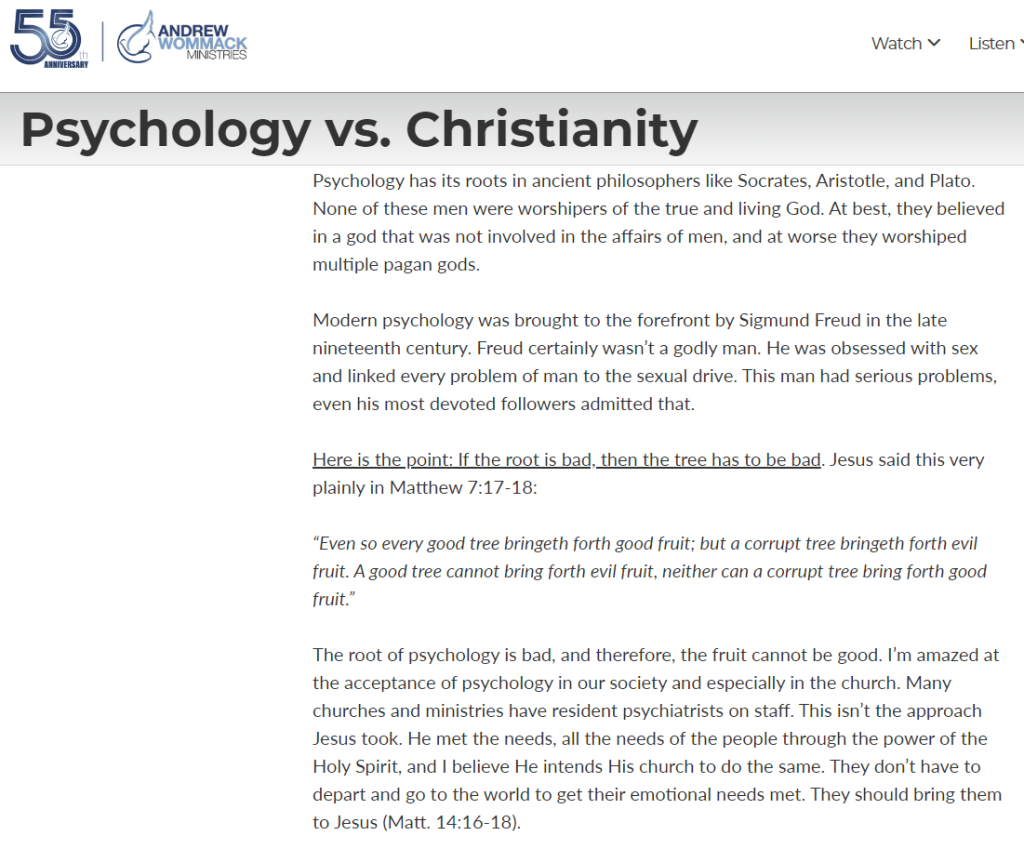
As Izzy pointed out in the video discussion, Wommack is also breaking a cardinal rule of exegesis by using a bible verse out of context. The verse is talking about people (as evidenced in verse 16 which Wommack conveniently omitted) specifically coming in the name of God, not scientific disciplines.
He’s also ignoring thousands of years of church history because those very same Greek philosophers that he names as evil influences of psychology have contributed to Christian apologetics for thousands of years. Plato and Aristotle in particular are the source of what is called the cosmological argument for the existence of God. Christians like William Lane Craig in modern times and Thomas Aquinas from the 13th century have utilised this logical argument that there must be a creator God who is eternal and exists outside of time and space. This logical argument has been used with great effect when debating atheists and other sceptics.
How did pagan philosophers reach the logical conclusion that there must be an eternal creator God who is vastly different to the pagan gods of Greek mythology? I think we have an explanation in Romans chapter 1 where the apostle Paul writes that everyone has some awareness of God, and nobody has an excuse for not knowing or believing. The ancient Greek world was fertile ground for the gospel because they understood the logic of it, and Paul presented the gospel to philosophers in Athens because they were interested in Acts 17:18-34.
The ancient Greeks may not have known who God was until they heard the gospel, but that doesn’t mean they were never seeking Him or aware that He existed. Paul quotes their own philosophers as evidence that God is real, and that the Greeks have an awareness of God. Is their philosophy perfect? No, and nobody is claiming that it is. Philosophy is just an attempt to figure out the world we live in and who we are. Same as science and medicine. It’s an exploration of the natural world which God created, so it shouldn’t contradict anything about God, and it’s an exploration of how human beings function, which is also something the bible explores in great depth.
Personally, I’ve found the bible to be a fascinating series of case studies on human behaviour and cognition, which is all psychology seeks to understand. The biblical explanation for why people are so difficult and why we live in such a messed-up world, is because God gave us free will and we use it to define good and evil in a very subjective and self-centred way. God’s creation was good, and rebellion against God has messed it up beyond recognition because human beings don’t really think about the bigger picture and our responsibilities in that bigger picture. Instead, we usually just think about instant gratification and petty short-term stuff which creates problems in the long term.
Psychology doesn’t really touch on spirituality much because that’s not their wheelhouse and they acknowledge that, but one of the first things I was taught at university was that psychology consistently finds that human beings are pretty irrational and delusional. We believe that we’re rational and knowledgeable and competent, but the true levels of our knowledge, competency and rationality are much lower than our self-image. This is consistent with what the bible says about human nature. This is just one example of psychology agreeing with the bible and vice versa.
In the next block of the article, Wommack claims that Freud is the founder of modern psychology, which is categorically untrue because the true founder of modern psychology was Wilheml Wundt who established the Institute for Experimental Psychology at the University of Leipzig in 1879. He predates Freud and employed a more scientific method to investigating human behaviour and cognitions. Freud only worked with case studies and developed his theories from there, which is not sufficient for the scientific method used to establish treatments or diagnosis.
Wommack is free to criticise Freud as much as he wants, because psychology has been doing it for decades. I think it’s hilarious that the extent of Wommack’s knowledge about modern psychology is Freud because that tells me his understanding is limited to pop culture.
Freud was a contributing member of psychology, but not by any means the founder and certainly not as influential as pop culture believes. Even a cursory google search would have informed Wommack of that much, so maybe he’s just too lazy to fact-check himself? I don’t know what his excuse is for such poorly researched statements. There’s also a lot of pop-culture misconceptions about Freud’s theories, that he was fixated on sex. A lot of the terms he used sounded sexual but didn’t necessarily have anything to do with that. For example, libido refers to the drive to survive and perpetuate genes, and the counterpart is Thanatos which is considered the death drive towards self-destruction. Libido in Freud’s theories represents the will to live, not a person’s sexual appetite.
Freud has not been widely taught or readily accepted in psychology since at least the 1960’s, which was when the behavioural school of thought became dominant. These days we are more likely to learn about cognitive psychology than psychoanalytic techniques. Students can specialise in psychoanalysis in their post-graduate study, but it’s not very common. There are much more effective treatments available now thanks to cognitive psychology and they take considerably less time and expense. Most psychology students learn about Freud in a historical background context rather than teaching students to believe his theories.
In the next stage of Wommack’s article, he tries to bring credibility to his assertions by claiming to have friends in psychology who agree with him. This could qualify as more logical fallacies such as bandwagoning, anecdotal evidence rather than direct quotes, or an appeal to authority:
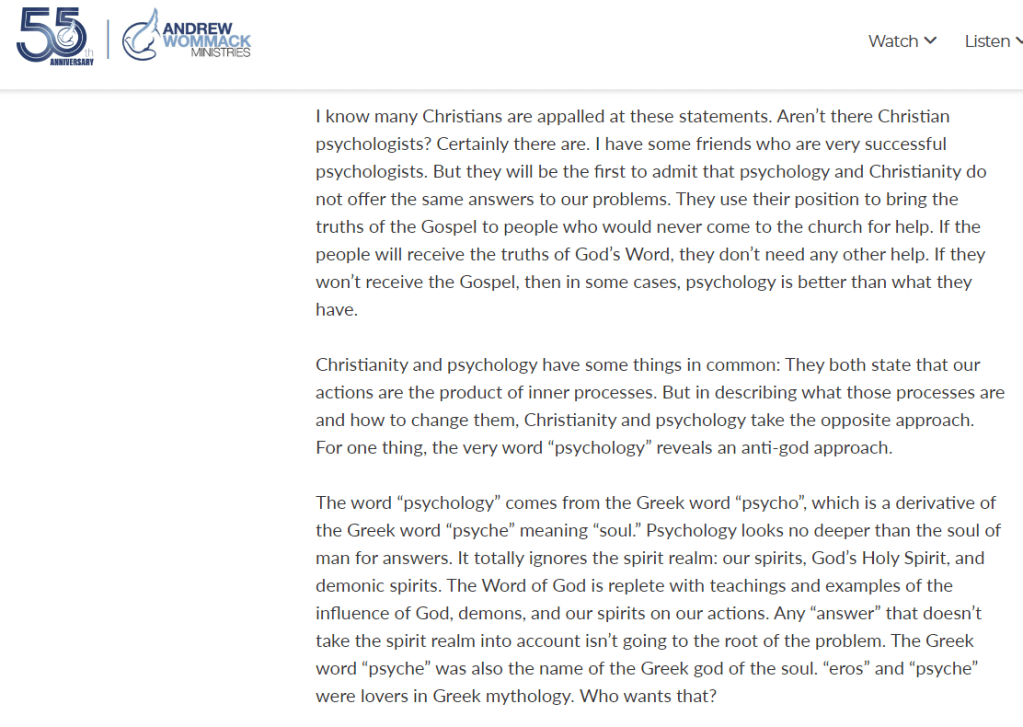
He seems oblivious to the irony that his authority comes from psychology itself, but that’s not particularly important.
Wommack says that he has Christian psychologist friends acknowledge that psychology does not offer what religion offers… because that’s true. Psychology is not attempting to replace spirituality. Any practitioner who does attempts to do such a thing is probably trying to start a cult. Therapists are supposed to stick to their lane, which is why I’m surprised that any of his psychologist friends are trying to evangelize while treating patients. Wommack writes: “They [his psychologist friends] use their position to bring the truths of the Gospel to people who would never come to the church for help.” It’s quite unethical to do something like that. If I went to a counsellor and they kept badgering me to become a Buddhist, I would leave and report them. It’s inappropriate in the role of a psychologist to push any religious belief.
Wommack’s next statement, using the authority and weight of his “psychologist friends” to back it up says; “If the people will receive the truths of God’s Word, they don’t need any other help.” That is suuuuuper dangerous. I have a friend at church who suffers from schizophrenia, and she needs real medical help. Religion can actually be a major stumbling block for her because she cannot always discern what is real and what isn’t and it’s very common for a range of different mental health disorders to over-spiritualize ordinary, physical things. People can develop paranoia, obsessions, and compulsive behaviours which negatively affect their ability to function in real life.
Another very telling error in this article, which makes me question his biblical literacy, is how he demonises the Greek language. In one section of the article he talks about the etymology of the word “psychology” as a way of proving it’s nefarious origins, even though etymology is a very weak argument for meaning because languages change over time. Psychology is apparently the boogeyman because it comes from the ancient Greek word “psyche” which was also the name of a Greek mythological character, a human who married Eros. However, Wommack now has some serious problems with the bible by saying that the Greek word “psyche” is evil, because the original Greek text of the New Testament uses that word to describe God’s soul. Matthew 12:18 – “Behold! My Servant whom I have chosen, My Beloved in whom My [psyche] soul is well pleased!”
Is Wommack saying that God’s soul is evil because the bible was written in Greek?
Strong’s concordance for the word “psyche” is number G5590 if anyone wants to cross-reference when and how it is used in the bible, but it is literally just an ordinary word for “soul” in the ancient Greek language. The way that psychology is using the word today is to express the comprehensive complexity of the mind, emotions, and physical experience. We are not worshipping Greek goddesses by studying human behaviour and cognition. It’s a ridiculous accusation to make.
In the next section Wommack contradicts himself. In one paragraph he says that Christianity and psychology agree that our actions stem from internal processes, but then two paragraphs later he claims that psychology lets people off the hook because we’re all just products of our environment and not responsible for our actions. This, to me, is a clear indication that Wommack knows that psychology is not contradictory to the bible, but he is deliberately creating a strawman version of psychology which he knows doesn’t exist.
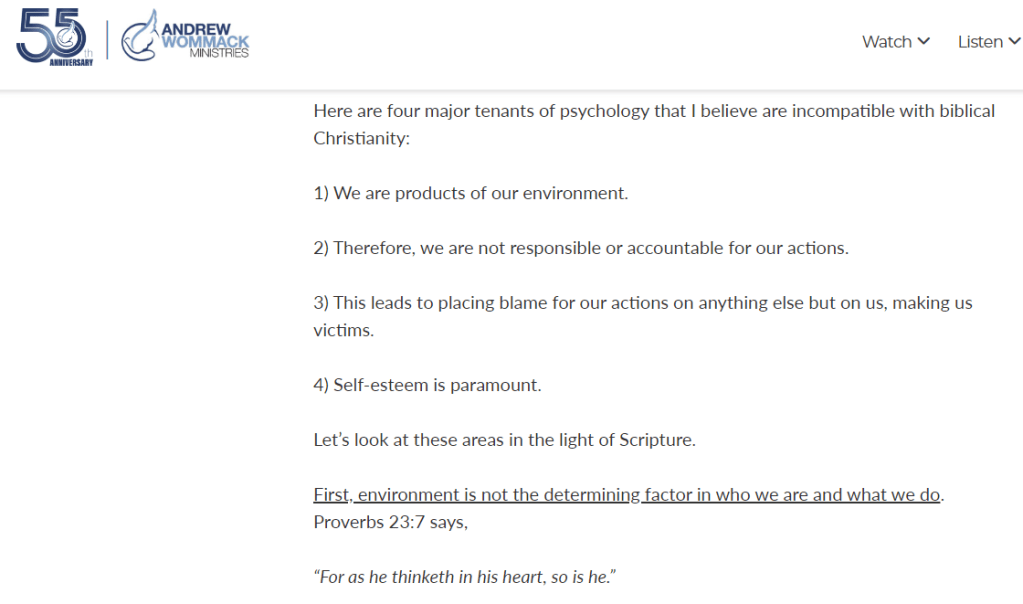
Psychology has never and does not claim that people are not responsible for their actions. What psychology does find and teaches to students, is that there is a mixture of nature and nurture. No situation is ever 100% one or the other, and the bible agrees with that. Wommack quotes Proverbs 23:7(a) which says: For as he thinks in his heart, so is he. However, that whole chapter is instruction against spending time with certain people and not putting yourself in the way of temptation. As it also says in 1st Corinthians 15:33, Do not be deceived; “Bad company corrupts good character.” Which is (interestingly) is a quote Paul uses from the Greek poet Menander.
His list of 4 “tenants” (I think he means “tenets” of psychology) are: People are products of their environment, which means they are not accountable for their choices, so they can blame everyone and everything else for their choices and play the victim, and everything about psychology is aimed at boosting self-esteem. Since he has already admitted that psychology talks about internal processes, I can only assume this is another strawman argument.
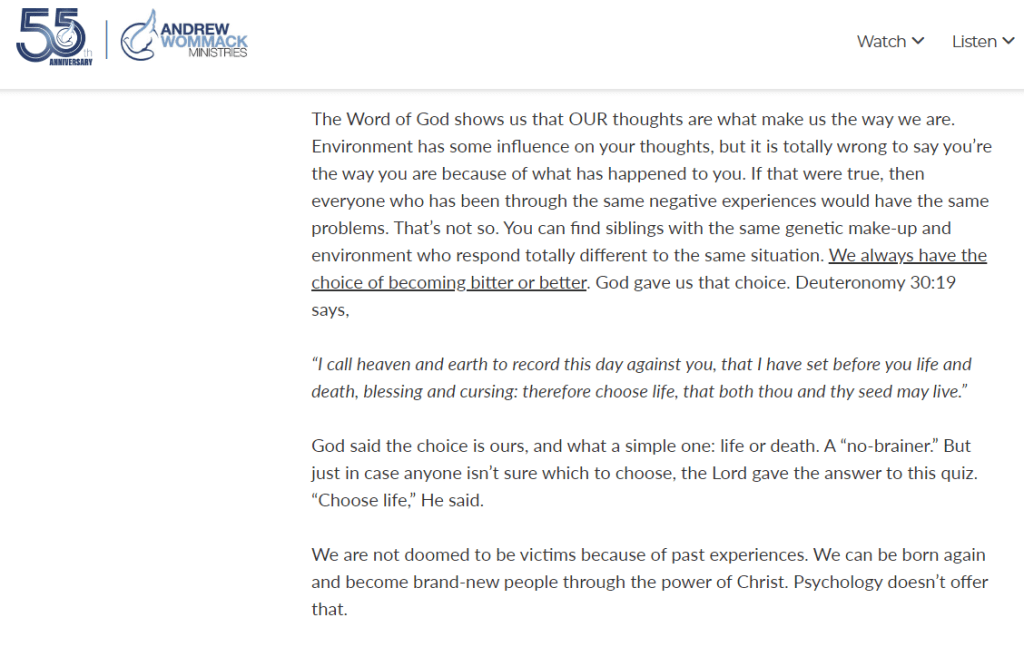
Psychology, by definition, is the scientific study of cognitions and behaviours in humans. Psychology is interested in how people think and how they behave. As I mentioned before, the underlying factors involved in those things are both the environment and how the person chooses to respond to the environment. We know from research and case studies that a very indulgent environment in childhood can produce entitlement and narcissism, something which the bible also affirms. However, major contributing factors to who a person becomes are their choices along the way, not just the environment they were raised in. Two children raised in the same household can turn into very different adults, which is something Wommack claims is proof that his arguments are true. The problem is psychology is not disagreeing with Andrew Wommack. Andrew Wommack is disagreeing with a strawman he created.
One of the main methodologies for treatment of psychological conditions is Cognitive Behavioural Therapy (CBT). CBT specifically targets people’s thought processes and challenges why they think the way they do about themselves and the world around them. For example, an adult patient might have developed learned helplessness in childhood because they genuinely were helpless to prevent abuse as a kid, but CBT would challenge the idea that the adult has no agency. Over time in therapy they would learn to take more responsibility and be proactive about making healthy changes in their own life.
There are different therapies for different problems. It depends on what the issue is as to how it gets treated, but keeping someone in a perpetual victim state is not the aim of any therapy. That’s not healthy. If someone has suffered horrific treatment, psychology wants them to gradually progress from victim to survivor, without dismissing what they went through, like Andrew Wommack seems to think is appropriate. There seems to be a concerning lack of compassion in this article for people struggling with mental health disorders.
As for self-esteem being paramount: no, that’s not the aim of psychology. He seems to be conflating self-help gurus with psychology, but they are not the same thing. Self-esteem in psychology is not a cure. There is a healthy balance of self-esteem where the person values their own wellbeing enough to be functional, but they aren’t so self-absorbed as to make their relationships dysfunctional. The aim of psychology is to help individuals to become functional. People need to be able to earn a living, take care of themselves physically (which is often a struggle for people suffering depression, they neglect things like personal hygiene), and people also need to have functional personal relationships. That is the primary purpose of psychology: to intervene when someone is unable to function well enough to sustain their needs in life and restore them to functionality. As a Christian myself, I personally believe that God can play a massive role in healing us mentally and emotionally, but psychology does not endorse any particular religion because that’s not its job.
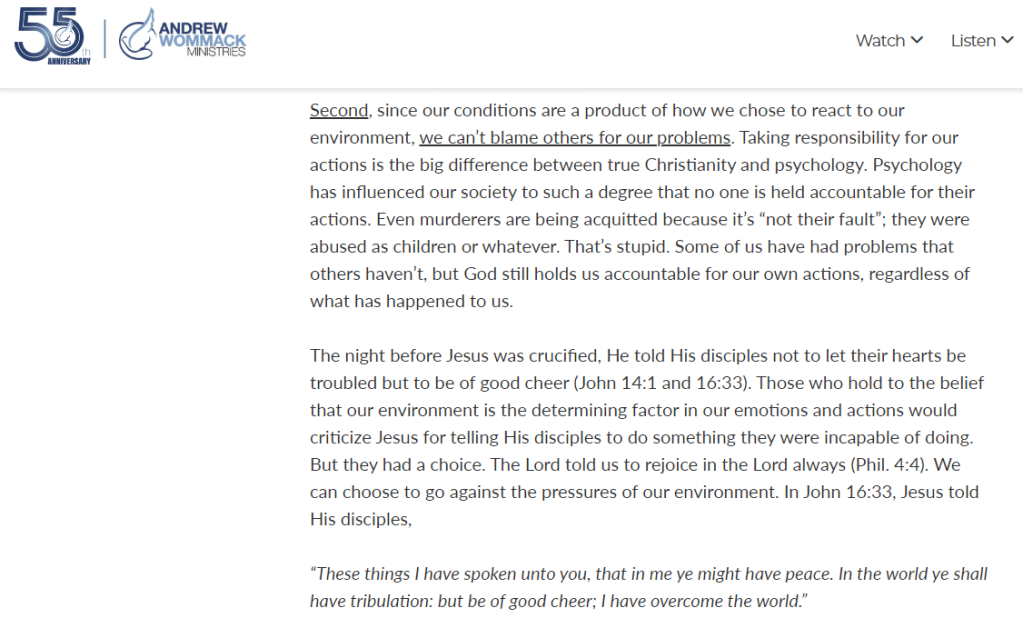
He claims that murderers are being released because they had rough childhoods. He doesn’t cite any specific cases where this happened, or give any evidence that psychology is responsible for gross negligence in the legal system. It’s just another claim without evidence. The insanity plea is not a get out of jail free card, even if defendants manage to make it work. Criminals who have successfully used the insanity plea end up incarcerated in mental institutions, they are not released back into the community. Often they end up serving more time than they would have in the prison system because their “sentence” is indefinite. They have to be declared cured and safe for release by medical experts.
When it comes to psychologists and psychiatrists screening defendants to stand trial, they are looking for intellectual impairments and other conditions which would make the person incapable of understanding the legal process. If a defendant fails the testing process to stand trial, they are kept in a psychiatric facility indefinitely, not released into the community where they pose a risk. If their innocence can be established, they may be released into care.
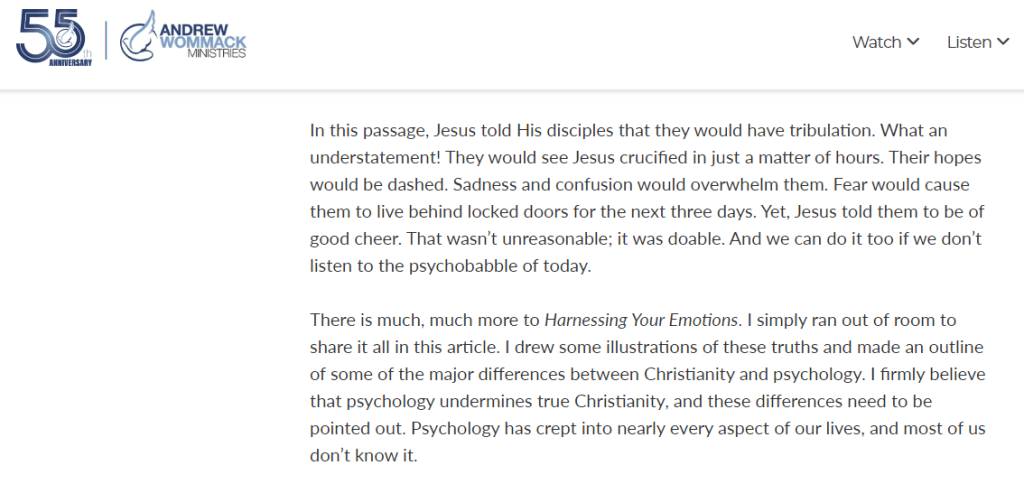
Wommack continues to agree with psychology for the remainder of the article, although his version lacks a great deal of nuance and compassion which psychology can offer. His version of psychology is a strawman which doesn’t even exist in the first place, so of course he believes that “psychology undermines true Christianity” when in reality neither undermines the other at all. He finishes by trying to sell a book which he has titled “Harnessing your emotions” in a shameless act of grifting. Unsurprisingly it appears to all come down to promoting himself, slandering a profession he knows very little about, and trying to make money.
References
Andrew Wommack Ministries. (May, 2020). Psychology v’s Christianity. https://www.awmi.net/reading/teaching-articles/psychology_christianity/
Berk, L. (2010). Development through the lifespan (7th ed., International ed.). Pearson/Allyn and Bacon.
Bible Gateway. (2023). 1st Corinthians chapter 15. New International Version. https://www.biblegateway.com/passage/?search=1%20Corinthians%2015:33-34&version=NIV
Burton, L., Westen, D., & Kowalski, R. M. (2012). Psychology (5th Australian and New Zealand ed.). John Wiley and Sons Australia.
Firmin, M. W. (2020). Alternative perspectives to Armando Simón’s “Goodbye Sigmund Freud: The case for exorcising the ghost of Freud from the field of psychology.” Journal of Human Behavior in the Social Environment, 30(1), 93–101. https://doi.org/10.1080/10911359.2019.1681342
Goldstein, E. B. (2019). Cognitive psychology : connecting mind, research, and everyday experience (5E. [5 edition]). Cengage Learning, Inc.
Hobson, T. (2018). Soul or Life? The Double Meaning of Psychē. Patheos. https://www.patheos.com/blogs/tomhobson/2018/05/soul-or-life-the-double-meaning-of-psyche/
Kuta, S. (2021). What Life Is Like for the ‘Criminally Insane’ at a Maximum-Security Psychiatric Hospital. A&E TV. https://www.aetv.com/real-crime/patient-experience-at-forensic-psychiatric-hospitals
Malcolm, L. (2015). A plea of insanity. ABC News. https://www.abc.net.au/listen/programs/allinthemind/mental-illness-and-the-criminal-justice-system/6535790
Sharf, R. S. (2015). Theories of Psychotherapy & Counseling (6th ed.). Cengage Learning.
Stanford Encyclopedia of Philosophy. (2022). Cosmological Argument. Stanford Encyclopedia of Philosophy. https://plato.stanford.edu/entries/cosmological-argument/
Step Bible. (2023). Psyche, Matthew chapter 12 verse 18. https://www.stepbible.org/?q=version=ESV%7Cversion=KJV%7Creference=Matt.12&options=NVUGVH&display=INTERLEAVED
 Louisa Watt