

What does the bible actually say about dating non-believers?
One of the key scriptures quoted in Christian dating content is this:
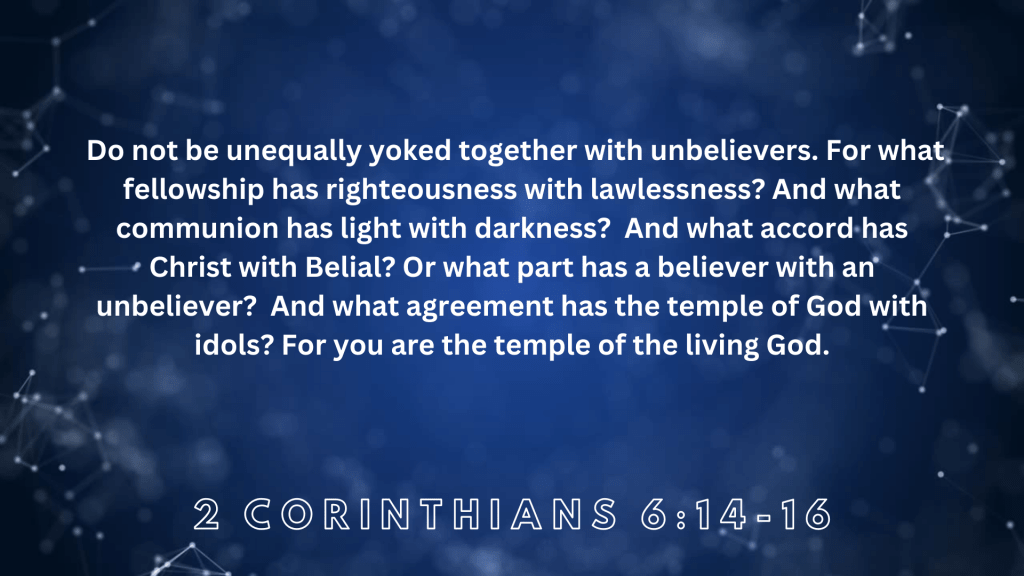
According to the dating advisors, this passage should be applied to dating, even though it is specifically talking about marriage. How is someone going to be able to discern where another person is at spiritually, unless they get to know them a bit first? After all, some people at church are spiritually checked-out and just go for the social aspect. Outward appearances are not always the best way to discern someone else’s spiritual walk. Applying a rule or principle from scripture too broadly and laying heavy burdens on people that they cannot bear is what pharisees do and it shows how weak that person’s faith has been if they do not believe other Christians can be trusted to discern what is acceptable to God through the dating process. Usually, it stems from their own past mistakes making them fearful, and they do not believe that anyone else can exercise good judgement when they couldn’t. Some people even try to insist that anyone you date must be at the same “spiritual level” as you, otherwise don’t give them the time of day, but how does anyone know what another person’s spiritual walk is unless they take the time to know them? Outward appearances can be deceiving (as we are often told in the bible), so just because someone does more at the church than someone else, does not make them “spiritually superior” to others. Again, it’s a superficial, pharisee kind of religious take on scripture. The bible itself is not that strict with who can be your spouse if one person becomes a believer after marriage:
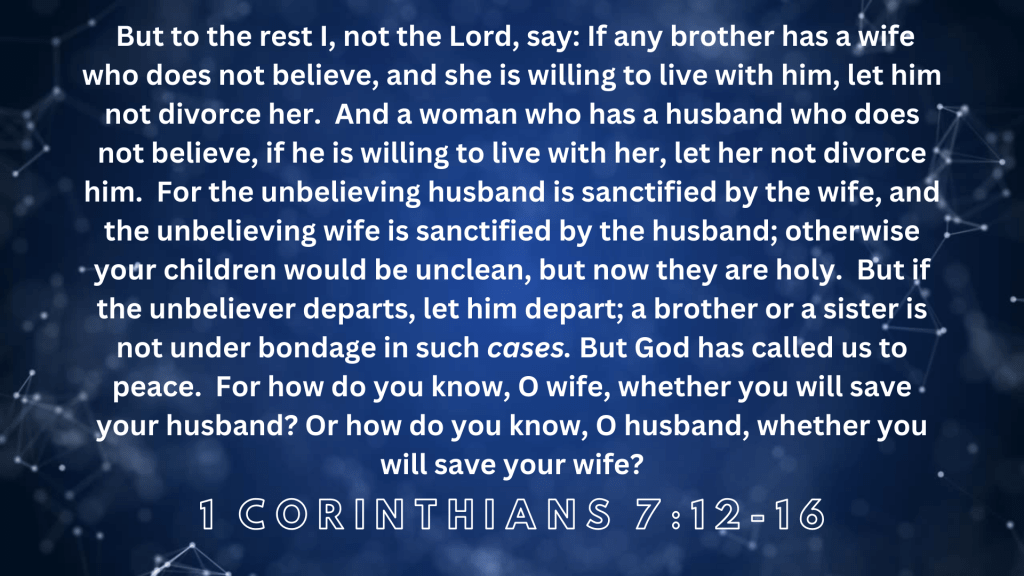
It makes me wonder if the dating pharisees would pressure people to get divorced in that situation. As Christians, we are called to be holy (which means set apart) and to be different from the surrounding worldly cultural norms, which also means looking beyond the outward appearance of a person and asking God for wisdom regarding their suitability for partnership. It also means bearing with people who are not always on the same page, not because we’re better than them, but because we made a commitment to them.
There are two major themes in these scriptures, which some people might think conflict with each other, but God is asking us to do both at the same time; protecting our faith/walk with God, while trying to reach the lost souls who God loves and wishes to redeem. That’s supposed to be the tension of being a Christian; we don’t join people in sin, but we appreciate their intrinsic value to God and share the good news with them through our lives.
The Christian content that teaches on 2nd Corinthians 6, is rife with a pharisee attitude that we as Christians are superior to non-believers, and this verse is evidence. It is only evidence that we are on different paths and one path leads towards life, while the other path leads to destruction, but people can change paths at any point through life, including Christians who are not watching how they walk. Christians have never been superior to the world, as Paul reminds the church:

Christians are not better than anyone else. We are failed human beings who have been redeemed. All we have is the borrowed righteousness of Christ which makes us acceptable to God because He had mercy on us, not because we deserved a second chance. Without Jesus we are the same lost souls as everyone else.
This belief in their own superiority that some Christians develop (when reading verses out of context and devoid of the reminders of the laws of love) is that it causes two potential outcomes which are both bad. First potential outcome is that the Christian becomes increasingly isolated from the rest of the world, out of touch with fellow human beings, and their sense of superiority gets worse. Because they rarely socialise with non-believers, or identify with their situation, they may begin to dehumanise them even more; treating them with contempt and neglecting to share the gospel. The second potential outcome is that the Christian does remember the humanity of the non-believer and sees their redeemable qualities, but it causes them to question their own faith because they have been taught that these people are not worthy of being loved. However, none of us are “worthy” because love doesn’t work that way.
Both of these outcomes essentially break the first two commandments for a Christian: “You shall love the Lord your God with all your heart and with all your soul and with all your strength and with all your mind, and love your neighbor as yourself.” – Luke 10:27.
The attitude of the pharisee creates a false dichotomy where the believer is forced to choose between loving God or loving people, but we are commanded to do both at the same time, always.
So what is the solution? Is there a third option where we can apply scripture to our daily lives, remain faithful to God, and love people all at once? I believe there is, because I have walked that fine line and discovered a few things along the way.
The first principle is to not be too rigid or legalistic by applying scripture in broader strokes than it was originally intended. The scripture was written for marriage, not for dating, but too many people on social media apply it to dating. God may introduce you to someone before they are a believer and if you immediately write them off without asking God first, or giving the person an opportunity to decide what they choose to believe, you might miss out on the blessings God has planned for you.
Secondly, dating is precisely the time when you discover if the person you are dating has a heart for God or not. That includes other Christians, not just unbelievers who are not familiar with the gospel. You can just as easily be unequally yoked with another professing Christian who has a bunch of issues they have not dealt with, as you can with a secular person.
Thirdly, your choice of spouse is always supposed to be decided in consultation with God, not off your own bat. Isaac’s wife, Rebecca, for example was chosen by God not by Isaac. How many times in scripture did people choose to do things their own way instead of listening to God and it failed epically? One example which comes to mind is Numbers 13 and 14 when the Israelites were told to take the promised land the first time and they balked at the strength of their opposition instead of trusting God. When God declared they would wander the wilderness for 40 years until the faithless generation had died out, they tried to salvage the situation themselves and attack when God had already told them they missed their opportunity. They were utterly defeated in battle because they went alone, without God. We can do the exact same thing in dating if we are disobedient to God when He tells us that the time and the person are right.
And finally, the fourth reason is because God can ask us to do some unconventional things sometimes which test our faith in Him. We think we know what God is going to do because we read the rule book, and we think we have it all figured out, but obedience goes well beyond just knowing the rules and following them. Obedience is having trust in God and knowing His voice when He tells you to do something or not do something. Just look at all of the strange things God asked the prophets to undertake, like Hosea marrying a prostitute or Ezekiel digging a hole through a wall to find a secret doorway. God often pushes us out of our comfort zones and asks us to take a risk when He knows it will ultimately pay off. He is, after all, playing the longest chess match in history, and he is several thousand moves ahead of anyone else. His purposes will always be fulfilled, whether we are with Him or against Him. We can either get on board or miss out on the blessings.
Are you faithful, even when it looks weird?

How I met my husband is not at all what I would have expected from God, and yet He was the one who introduced us. In 2021 I had been divorced for almost three and a half years, but I had only been saved for just over one year. That relationship had been physically abusive, which left me fearful of intimacy. I had tried dating apps for the first time about a year after we split up, thinking that Bumble might be the least threatening platform to try, but it was predictably a dumpster fire riddled with people who had significant issues (myself included). I was a practicing pagan/psychic medium at the time, so I couldn’t be further away from God if I tried. So after that terrible experience, the last thing I expected from God was to be sent to find someone on tinder. At first I scoffed, but then I had two confirmations that week from Christian sources and my stomach sank. Anything but that.
Despite my complete skepticism, I did as I was told, reassuring myself that this was just God’s way of road-testing my healing journey. He didn’t really expect me to date anyone. I wasn’t ready. He knew that.
As I had anticipated, there were the usual guys who saw the “Christian” label on my profile and just thought of it as a challenge rather than a boundary. I was willing to talk to anyone, as long as they understood what dating me would entail and they respected my choice to take faith seriously. It was a non-negotiable, so when they tried to push the issue, I thanked them for their time and said that wasn’t what I was looking for before cutting the conversation off. I met some professing Christians on the app who were not much of an improvement on the rest of the guys, often either ghosting me or putting in negligible amounts of effort. Because I didn’t really think I was there to date, I didn’t just accept the breadcrumbs, or try harder to get someone’s attention if they played games, or worry about someone dropping out, or compromise my standards. Ultimately, there was only one left: Thomas.
Thomas was different from the rest. He wasn’t trying to get flirty with me, but instead wanted to find out who I was as a person. I didn’t feel the need to censor my thoughts in our conversations, nor did he make me anxious. We talked freely and openly about many things, and he seemed curious about my faith instead of trying to get it out of his way. Sometimes both Christians and unbelievers treat other people’s faith like an obstacle between them and what they want, which is why we have the advice in 2 Corinthians to not get married to that.
When we eventually started dating, after a month of text conversation, he respected my boundaries and wasn’t trying to push them. He had all the qualities that Christians are supposed to have; patience, self-control, gentleness, kindness, etc… but he had never been to church and was not raised Christian. After a few weeks getting to know each other in person, I shared my testimony (which is pretty wild, so I don’t usually lead with that when I first meet people) and he calmly listened, nodding as I went. He seemed to be thinking it over, trying to sort it out in his own mind, which is understandable, so I left him to it and chatted about more ordinary things. He was either going to think I was crazy, or it would challenge his perception of reality. Later, I told him about getting the push from God to be on tinder at that time and how I hadn’t felt ready but trusted that God was good and there must be a reason for it.
A little while later, Thomas confided that he was dealing with some health issues and had to go for day-surgery to find out exactly what was wrong. When he eventually got the results, it was bad news: he was diagnosed with two autoimmune diseases which would shorten his life expectancy (IBD and PSC). It suddenly hit me that God asking me to date when He did had not been about me as much as I thought it was. God knew what was about to happen in Tom’s life, and even though Tom was not a Christian, God cared about his struggles enough to send support in the form of someone who had previously battled chronic ill-health for almost a decade: me. I had been down the road of gut illness, chronic fatigue, and feeling isolated because nobody wants to socialise with someone who is on an exclusion diet. I had been prepared for what was to come, so I could respond with empathy instead of running away from the difficulties ahead or resenting Tom for his weaknesses, as I had previously experienced in marriage.
At the same time, Thomas was hit with the thought that there was a God who cared about his problems and would not abandon him at his darkest hour. That sort of love is very disarming, so Thomas began to explore Christianity for himself, starting with the Alpha course, which happened to be run by a childhood friend of his. Neither of them had been Christian when they played cricket together, but here they were crossing paths again in their 30’s after losing touch. Tom found himself connected to a community of Christians who offered support and encouragement, including another friend of mine who had previously battled IBD as well.
If I had listened to the Christian dating pharisees, where would Tom and I be today? Probably not married. Probably not witnessing God’s love firsthand in our lives. Probably not enjoying the blessing of having each other for support when things get tough.
Obedience to God is more than knowing all the rules and making them even harder for yourself than they are supposed to be. Obedience to God can look unconventional, but we are called to trust Him and to be led by the Spirit. If we refuse to do that because of a legalistic culture, then we are in disobedience and our faith is weak.
 Louisa Watt